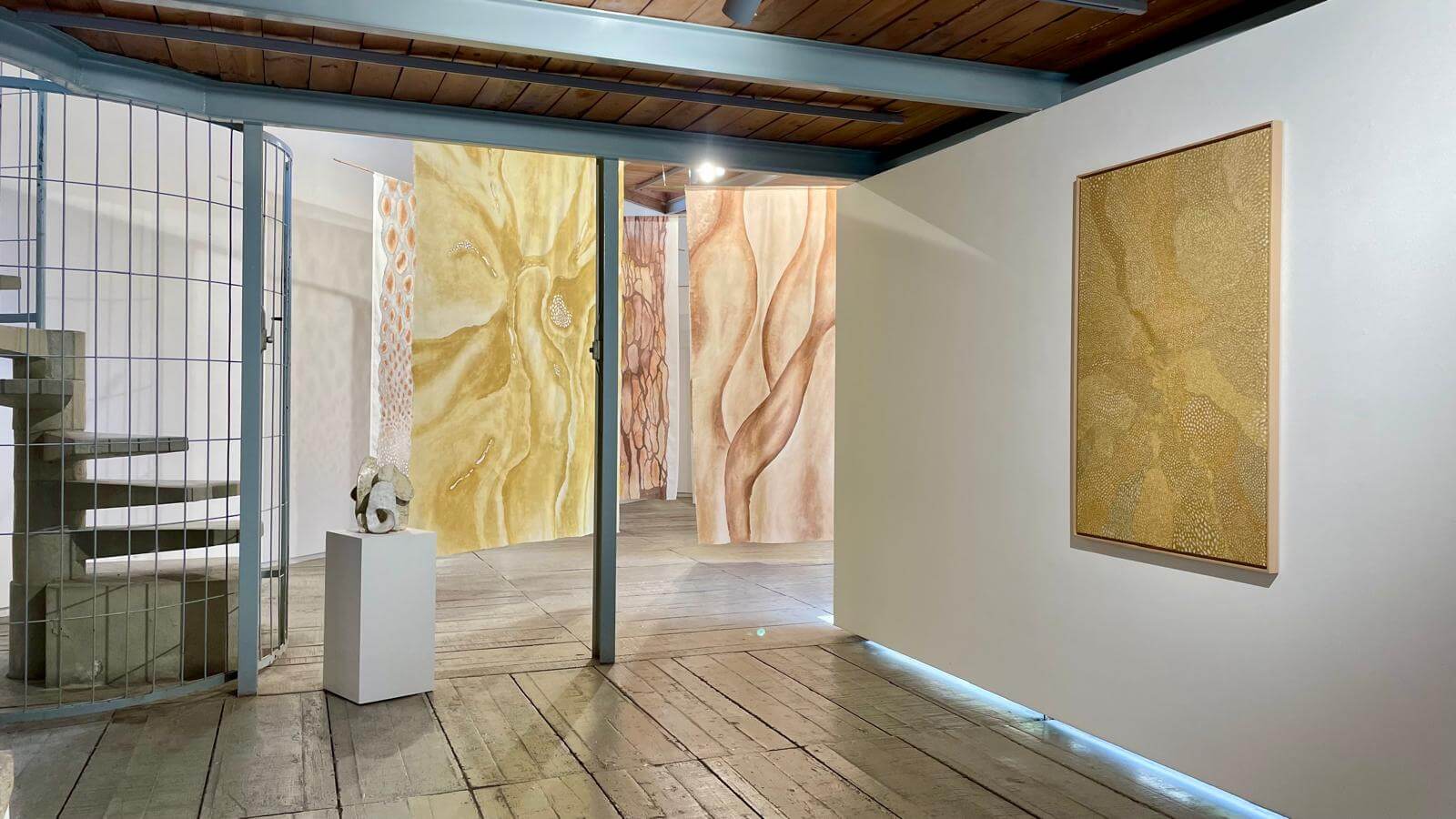
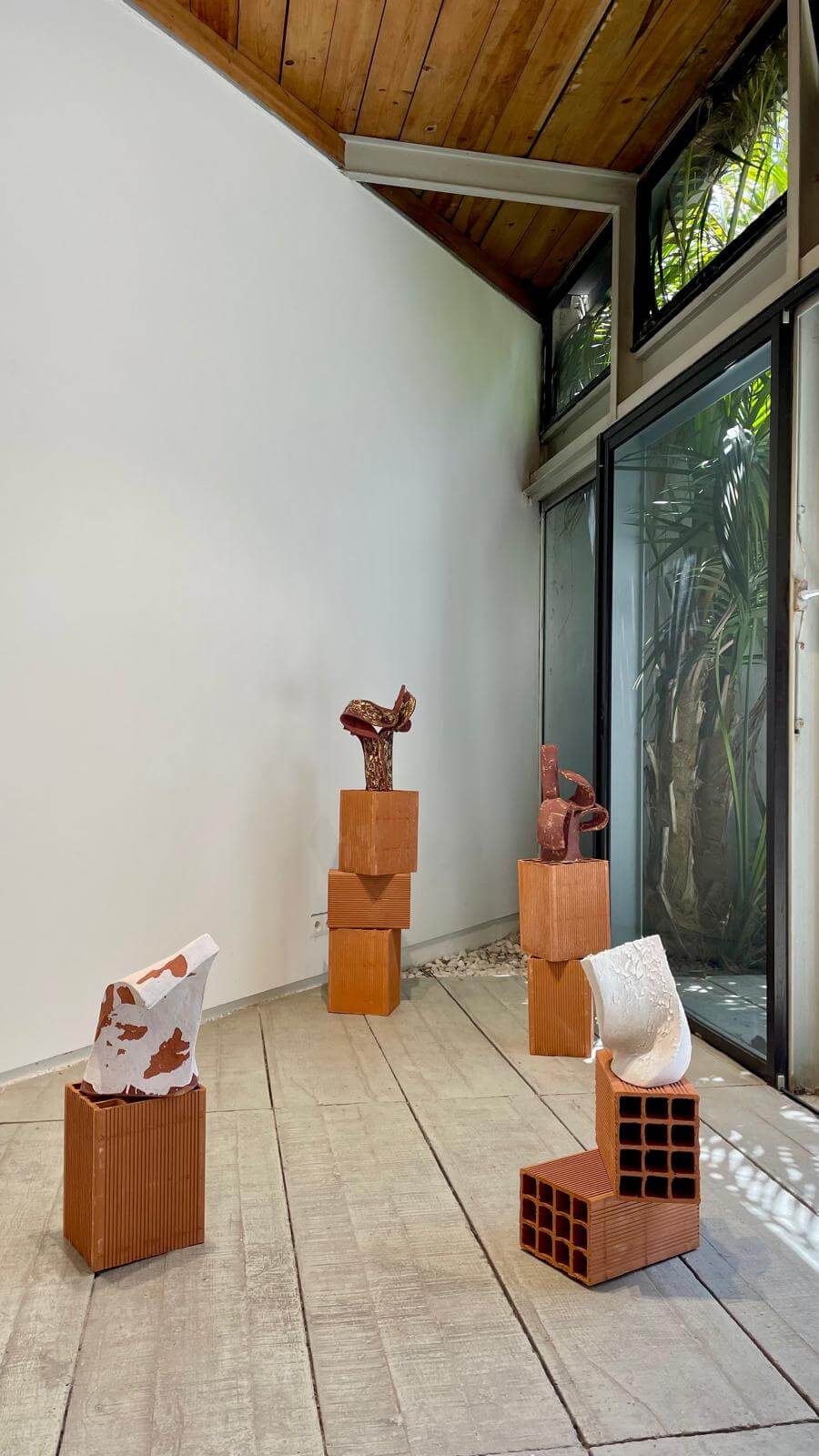
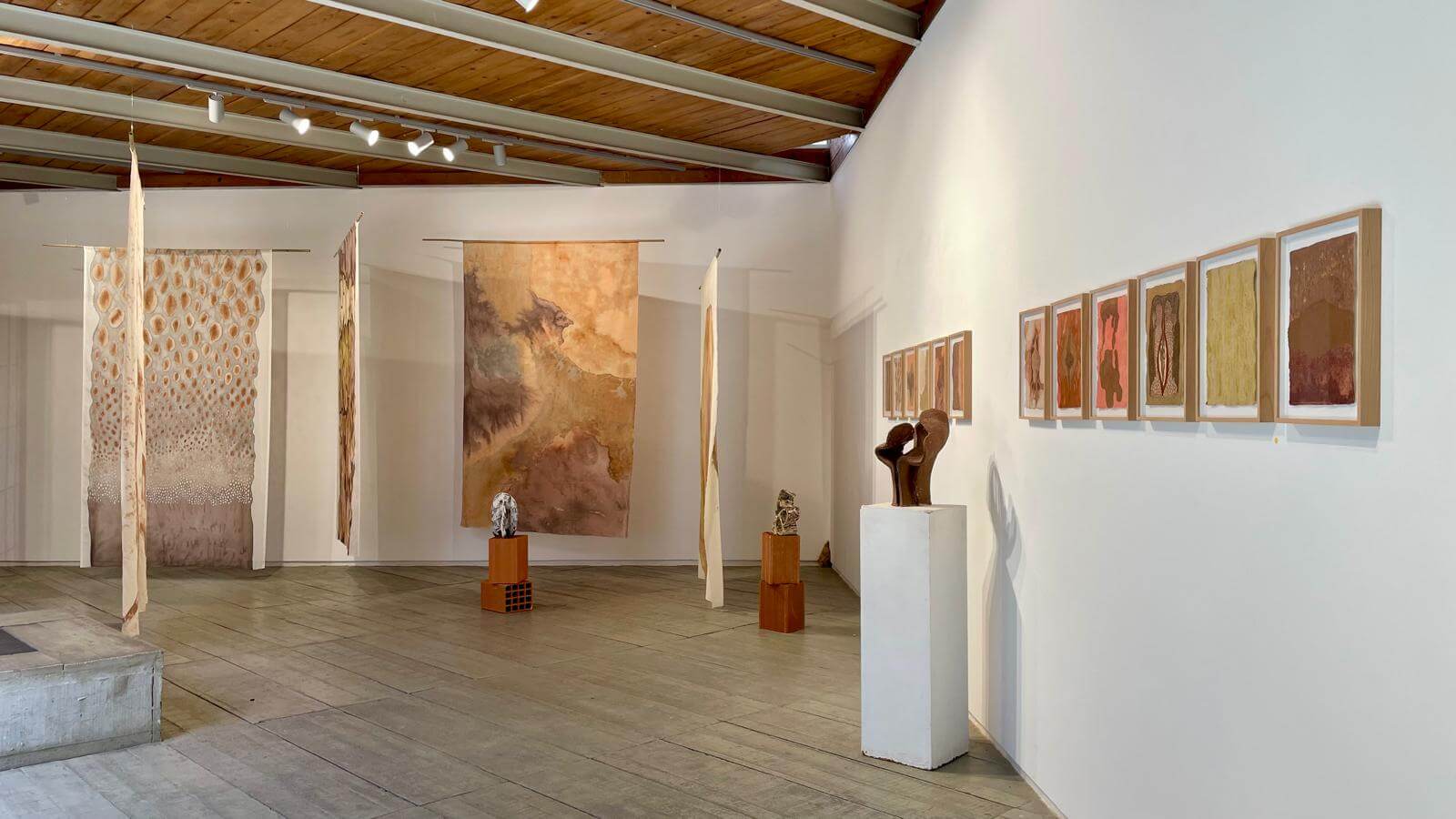
Resilient Transitions é uma exposição site-specific que convida o público a entrar num ambiente imersivo onde pintura e escultura se entrelaçam num diálogo contínuo com a matéria e o tempo. Num contexto marcado por instabilidade e transformação, as artistas Franka e Vania exploram a resiliência como um processo vivo - não como resistência, mas como capacidade de adaptação e metamorfose. Através de superfícies minerais, formas tensionadas e gestos em constante evolução, a exposição propõe uma
experiência sensorial e reflexiva que desafia o espectador a repensar a sua relação com a mudança e com os sistemas que habita.
Resilient Transitions revela-se como um ambiente site-specific concebido para ser habitado, onde a natureza é compreendida como um campo vivo e unificado, em que matéria, corpo e pensamento são indissociáveis. Sob esta perspetiva, a transformação não é a exceção, mas a condição fundamental da existência: tudo persiste, adapta-se e evolui numa mudança incessante.
Num mundo marcado pela aceleração, pela fragmentação e por uma precariedade ecológica crescente, a exposição abre um espaço de reflexão profunda. Em vez de oferecer respostas definitivas, coloca uma questão vital: como podemos evoluir de forma significativa dentro de sistemas que não conseguimos controlar totalmente? O que nos impele a perseverar, a ativar as nossas capacidades latentes e a continuar a crescer mesmo em condições de incerteza? Neste lugar, as obras não se apresentam como objetos discretos ou acabados, mas como encontros. Forças naturais, temporais e corporais deslizam entre si, dissolvendo-se e reaparecendo numa narrativa que não admite um estado final, tornando o espectador não um observador externo, mas um elemento imerso no fluxo.
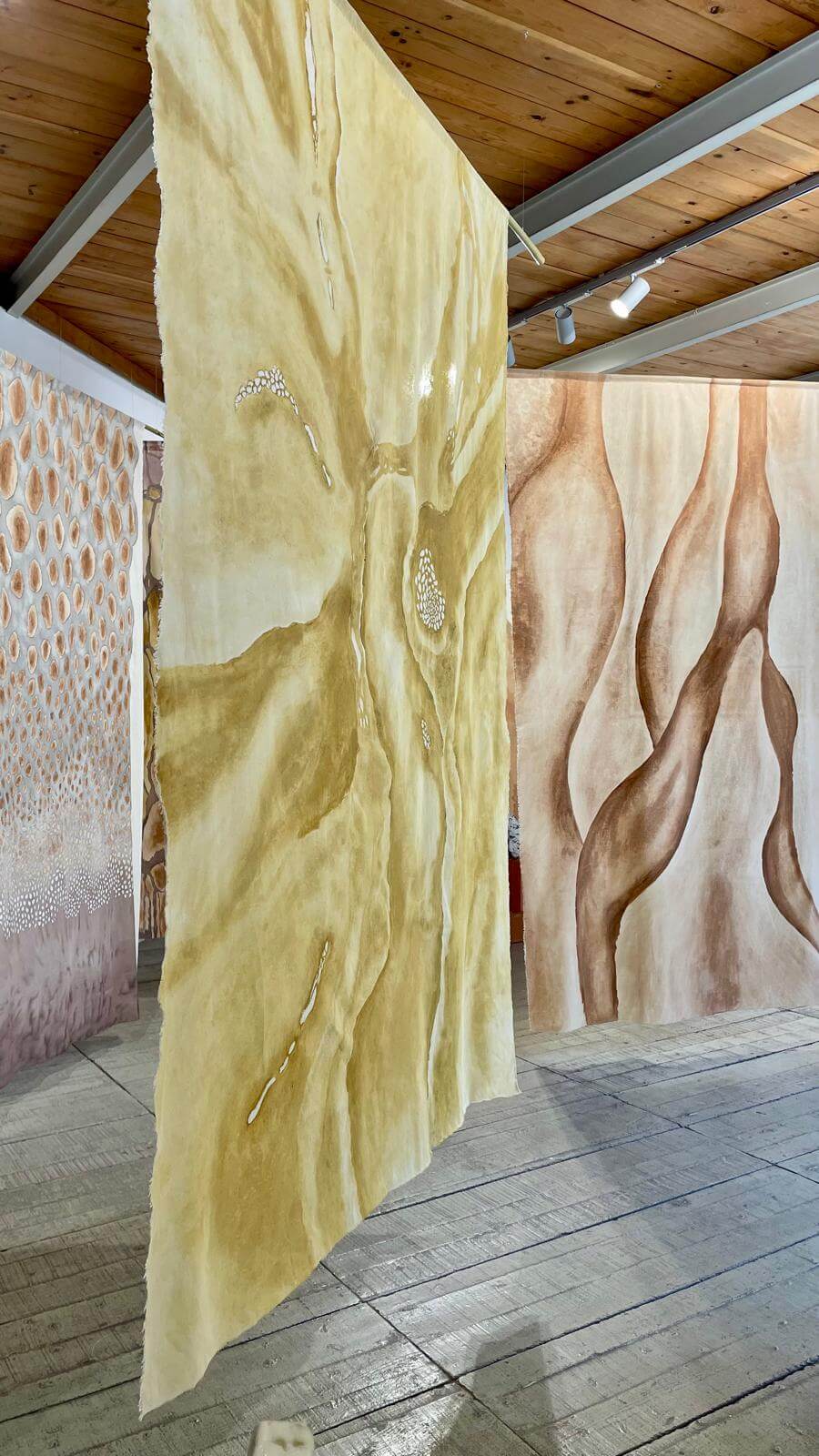
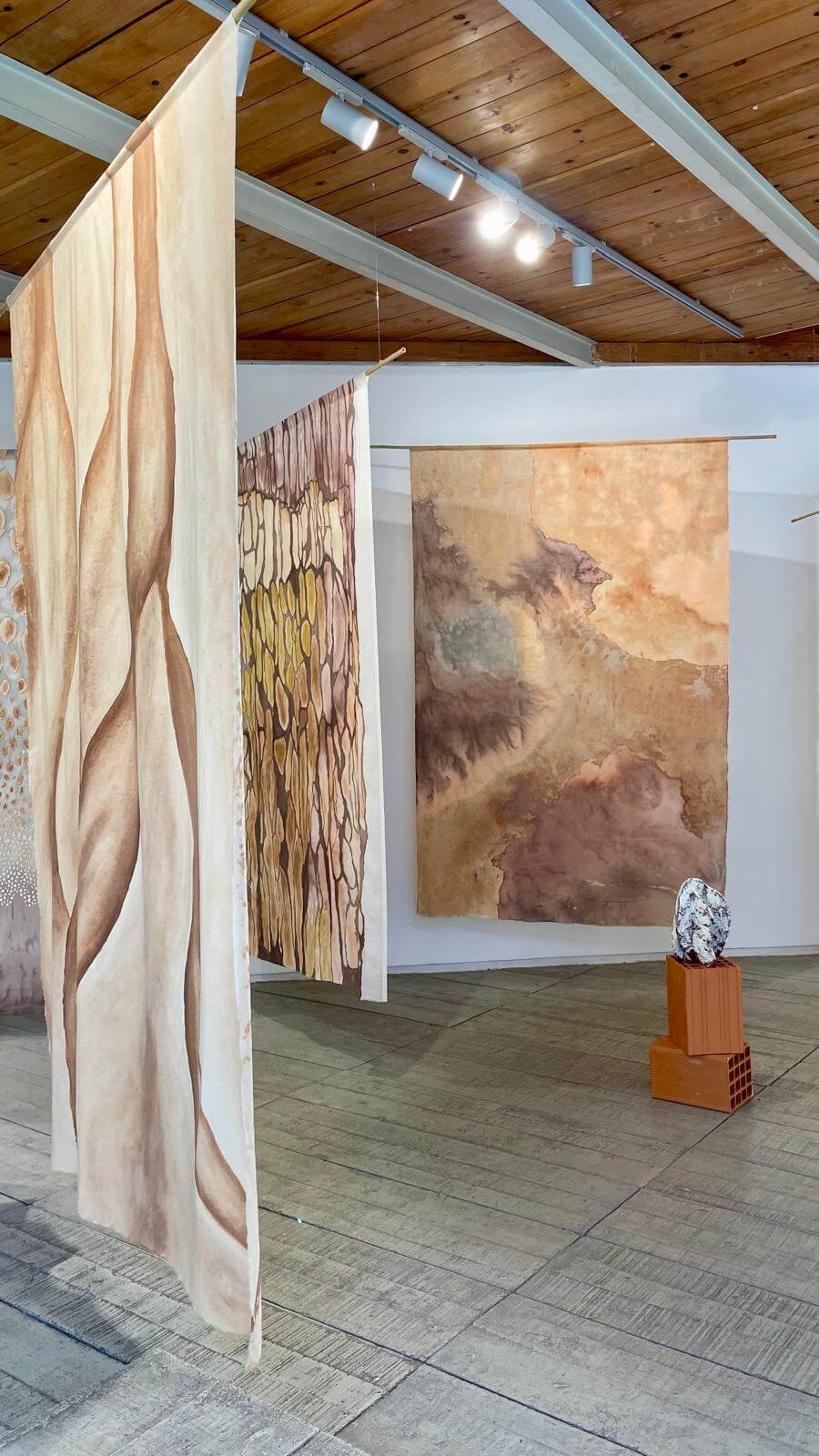
As pinturas de Franka, criadas com pigmentos minerais e granito pulverizado, não representam imagens, mas evocam uma memória sedimentada. As suas superfícies tácteis, inspiradas pela força geológica das falésias costeiras, capturam o tempo como um rasto aberto; cada gesto permanece suspenso entre o controlo consciente e a entrega ao material, refletindo a força incansável da natureza, que se molda num devir contínuo.
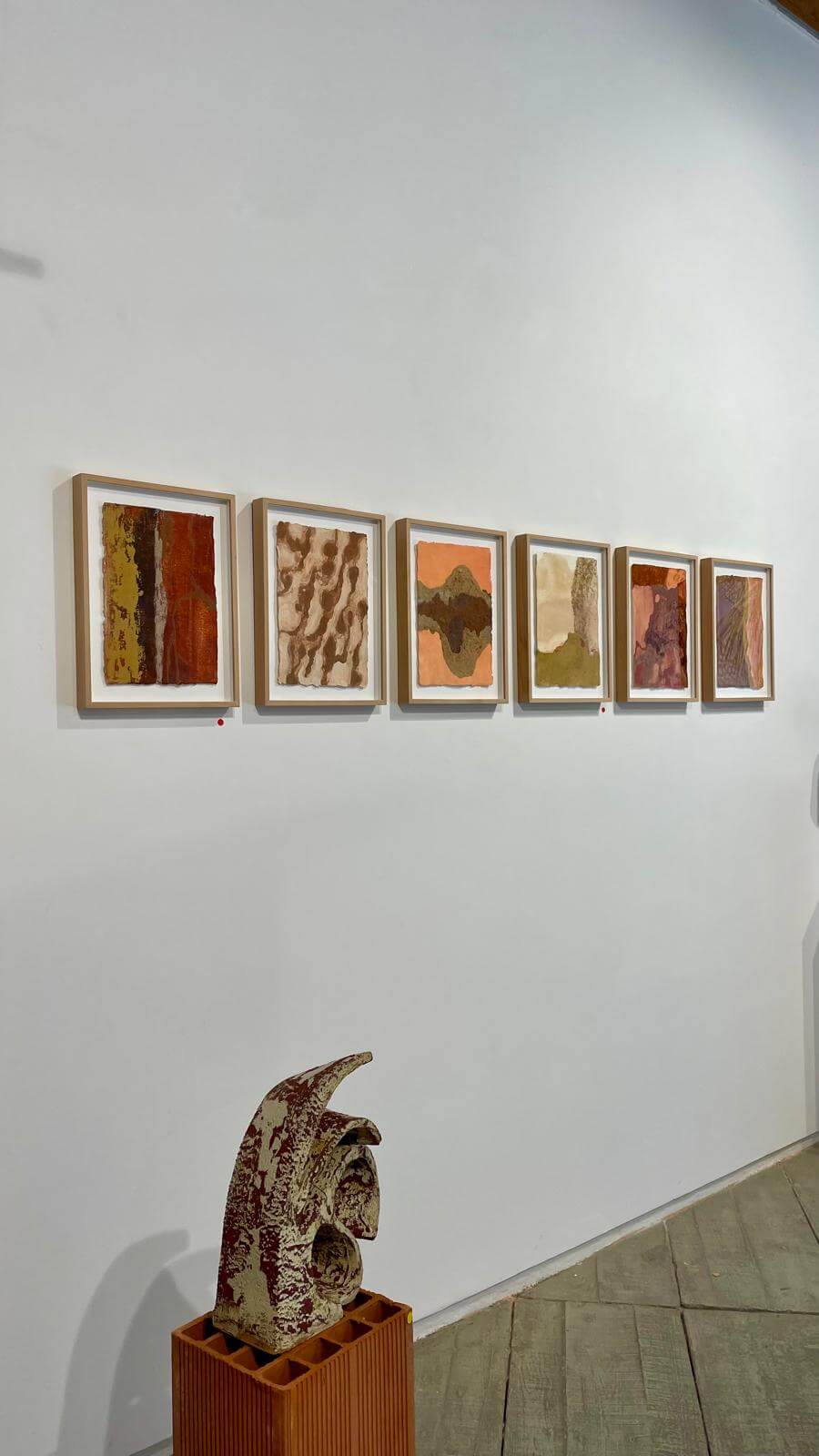
Em paralelo, as esculturas de Vania movem-se com uma densidade tensa: construídas através de ciclos de modelação manual e de queimadas repetidas, encarnam a fragilidade inerente ao peso e a instabilidade da forma. As suas superfícies acumulam-se como camadas de pele ou terrenos erodidos, marcadas por fraturas e depósitos que emergem da interação entre a matéria e o calor; aqui, a resiliência surge não como uma resistência rígida, mas como a capacidade profunda de absorver a mudança, reorganizar-se e persistir
através da metamorfose.
Entre a bidimensionalidade da pintura e a fisicalidade da escultura, delineia-se um campo intersticial onde as obras não se isolam, mas se implicam e se estendem umas nas outras, gerando uma condição espacial partilhada. Dentro da arquitetura triangular da galeria, emerge um percurso subtil - não imposto, mas descoberto através do movimento - tornando o próprio espaço parte integrante da obra: um ambiente construído que respira e convida à coabitação.
Ambas as artistas resistem ao fechamento de significados fixos, permanecendo focadas no processo e naquilo que ainda está em potência; nesta abertura, a vulnerabilidade torna-se um método de investigação e a matéria é deixada livre para negociar consigo mesma. A ligação emerge, assim, como uma resposta vital à incerteza, transformando o ato de nos unirmos - através da prática artística e da colaboração - numa forma de navegar a precariedade do presente.
O corpo, estendido à superfície, surge como um ato simultaneamente poético e político, desafiando a sensibilidade do espectador e convocando uma relação mais consciente com aquilo que vê e sente. Não aparece como espetáculo, mas como uma forma de atenção sustentada e de transformação interior. A beleza, neste contexto, não se afirma; emerge discretamente onde o pigmento se aglomera ou se dissolve, onde a forma cede perante aquilo que não consegue conter por completo.
A dimensão instalativa procura interromper lógicas estabelecidas e propor novas possibilidades de relação, colocando o observador dentro de um sistema social em constante tensão e reorganização. O espaço deixa de ser apenas um lugar de contemplação e transforma-se num território de negociação, deslocamento e consciência coletiva.
No seu cerne, Resilient Transitions é um convite à coragem de permitir-se transformar, lembrando-nos de que a adaptação não começa com o controle, mas com a vontade de reimaginar os sistemas que habitamos. Esta exposição resiste a uma resolução definitiva, revelando-se como um sistema vivo de relações e transformações lentas que nos convida a considerar-nos não como identidades fixas, mas como potencialidades que persistem na mudança. Neste espaço, o tempo não erode: inscreve-se profundamente. E as obras continuam, silenciosas e insistentemente, a tornar-se.
Federica Elena (curadora)
Resilient Transitions is a site-specific exhibition that invites the public to enter an immersive environment where painting and sculpture intertwine in a continuous dialogue with matter and time. In a context marked by instability and transformation, the artists Franka and Vania explore resilience as a living process - not as resistance, but as a capacity for adaptation and metamorphosis. Through mineral surfaces and ever-evolving gestures, the exhibition proposes a sensory and reflective experience that challenges the viewer to rethink their relationship with change and with the systems they inhabit.
Resilient Transitions (ENG)
Resilient Transitions unfolds as a site-specific environment conceived to be inhabited, where nature is understood as a unified living field in which matter, body, and thought are inseparable. Within this perspective, transformation is not the exception, but the fundamental condition of existence: everything persists, adapts, and evolves through unceasing change.
In a world marked by acceleration, fragmentation, and widespread ecological precarity, the exhibition opens a space for profound reflection. Rather than offering certain answers, it poses a vital question: how can we evolve meaningfully within systems that we cannot fully control? What drives us to persevere, to activate our latent capacities, and to continue growing even under conditions of uncertainty? In this place, works are not presented as discrete or finished objects, but as encounters. Natural, temporal, and corporeal forces slide into one another, dissolving and reappearing in a narrative that accepts no final state, rendering the viewer not an external observer, but an element immersed in the flow.
Franka’s paintings, created with mineral pigments and pulverized granite, do not describe images but evoke a sedimented memory. Her tactile surfaces, inspired by the geological force of coastal cliffs, capture time as an open trace; every gesture remains suspended between conscious control and surrender to the material, reflecting the tireless force of a nature that models itself in continuous becoming.
In parallel, Vania’s sculptures move with a density charged with tension: built through cycles of manual modeling and repeated firings, they embody the fragility of weight and the instability of form. Their surfaces accumulate like layers of skin or eroded terrain, marked by fractures and deposits that emerge from the interaction between matter and heat; here, resilience appears not as rigid resistance, but as the profound capacity to absorb change, reorganize, and persist through metamorphosis.
Between the bidimensionality of painting and the physicality of sculpture, an interstitial field emerges where the works do not exist in isolation, but rather implicate and extend into one another, generating a shared spatial condition. Within the triangular architecture of the gallery, a subtle pathway unfolds - not imposed, but discovered through movement - transforming the space itself into an integral part of the work: a constructed environment that breathes and invites cohabitation.
Both artists resist the closure of fixed meanings, remaining committed to process and to what still exists in a state of potentiality; within this openness, vulnerability becomes a method of inquiry, and matter is left free to negotiate with itself. Connection thus emerges as a vital response to uncertainty, transforming the act of coming together - through artistic practice and collaboration - into a way of navigating the precariousness of the present.
The body, extended across the surface, appears as both a poetic and political act, challenging the viewer’s sensibility and calling forth a more conscious relationship with what is seen and felt. It does not emerge as spectacle, but as a form of sustained attention and inner transformation. Beauty, in this context, does not assert itself; it quietly surfaces where pigment gathers or dissolves, where form yields to that which it cannot fully contain.
The installation dimension seeks to interrupt established logics and propose new modes of relation, positioning the observer within a social system in constant tension and reconfiguration. Space ceases to function merely as a site of contemplation and becomes instead a territory of negotiation, displacement, and collective awareness.
At its core, Resilient Transitions is an invitation to embrace the courage of transformation, reminding us that adaptation does not begin with control, but with the willingness to reimagine the systems we inhabit. The exhibition resists definitive resolution, revealing itself instead as a living system of relationships and slow transformations that invites us to consider ourselves not as fixed identities, but as potentialities that persist through change. Within this space, time does not erode: it inscribes itself deeply. And the works continue, silently and insistently, becoming.
Federica Elena (curator)
Vânia R. Gonçalves (b. 1978, Portugal) is a Lisbon based ceramic artist whose sculptural practice explores transformation through form, surface and material process. Working primarily with clay, she creates abstract forms that evoke movement, tension and organic growth, often suggesting landscapes shaped by erosion and geological time.
Gonçalves began her artistic path after a previous career in dentistry in London, later returning to Portugal to study ceramics at Ar.Co – Centro de Arte e Comunicação Visual in Lisbon. Her work has since been presented in exhibitions including Lisbon by Design, Dubai Design Week, and Thrown Gallery in London, among others.
Through experimentation with glaze chemistry, layering and multiple firings, her sculptures develop surfaces that shift between control and unpredictability. Recent work explores the body as landscape, reflecting on adaptation, aging and the traces of lived experience.
She lives and works in Lisbon, Portugal.
Franka Struys is a Dutch visual artist based in Lisbon. After graduating in Economics from Erasmus University Rotterdam in 1990, she pursued a diplomatic career before moving to Portugal. In 2009, she dedicated herself fully to art and studied painting at Ar.Co.
Living in Colares since 1998, Franka incorporates locally collected natural minerals into her painting techniques. Inspired by walks and meditative experiences along the Portuguese west coast, she creates imaginary landscapes that reflect a deep connection with nature. Her work explores ways of simplifying the complexity and uncertainty of contemporary life, searching for balance and harmony.
Since 2013, her work has been exhibited in Portugal and the Netherlands. She participated in artist residencies at RAMA-Residencies (2021-2022) and Córtex Frontal (2024), both in Portugal. Her work can be found in municipal and private collections in Portugal and abroad.
Franka also develops collaborative projects and facilitates painting workshops.